
Bringing a fortified food, functional beverage, or supplement to market is rarely about a single ingredient — it is about getting a whole system of vitamins, minerals, and actives to work together, stay stable, and hit your label claims batch after batch.
That is exactly the job of a custom premix manufacturer. Instead of sourcing, testing, and scaling a dozen raw materials yourself, you hand a single, purpose-built blend to your production line.
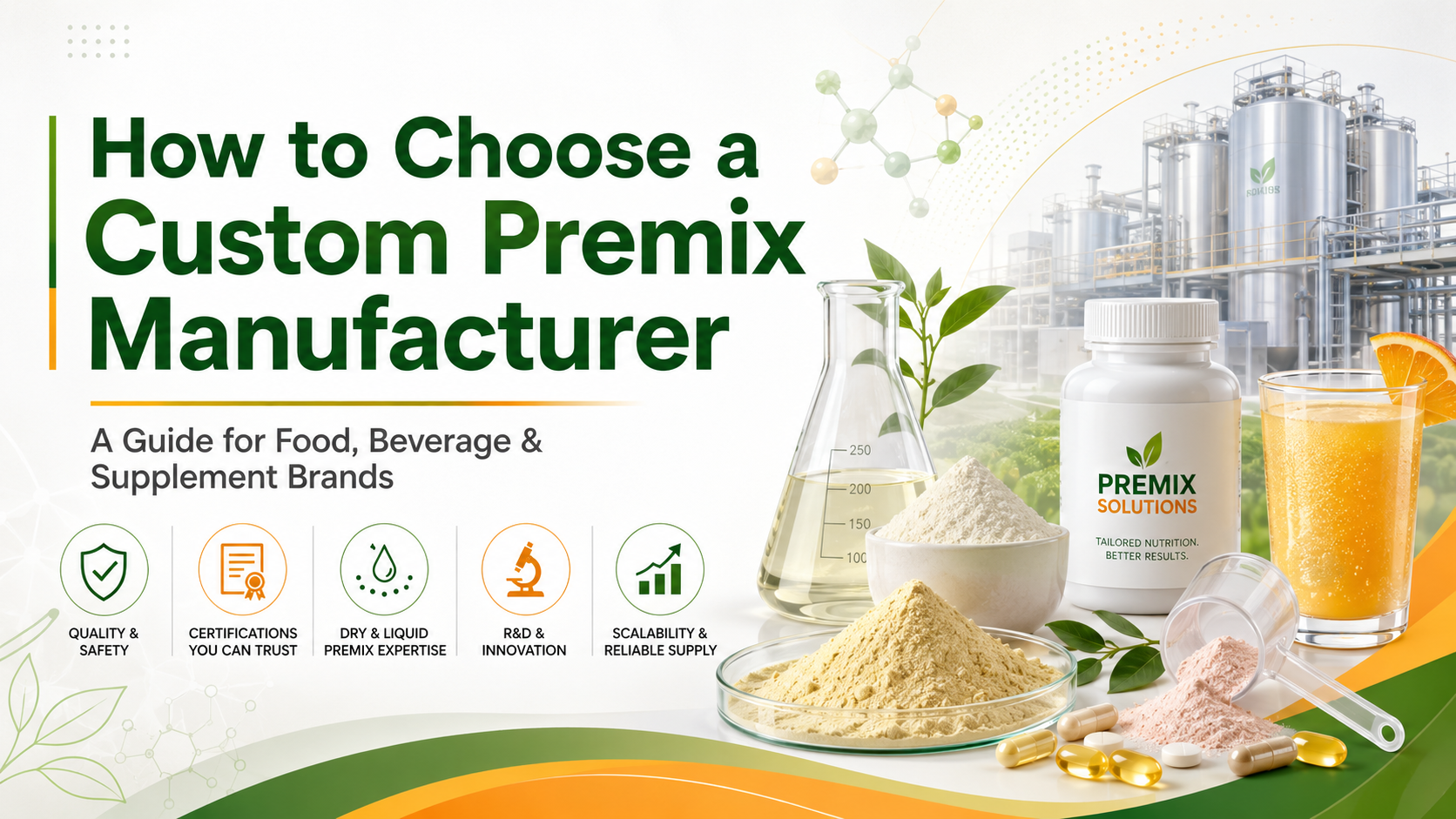
This guide covers what a custom premix is, how dry and liquid formats differ, and most importantly, how to choose a custom premix manufacturer that can deliver on your spec, your timeline, and your quality standards.
What Is a Custom Premix?
A premix, also called a nutrient premix or fortification premix, is a pre-blended combination of vitamins, minerals, amino acids, botanicals, and other functional ingredients, formulated to a precise specification and added to a finished product during manufacturing.
A custom premix is built around your formulation rather than pulled from a catalog — the actives, ratios, overages, carriers, and particle sizes are all chosen for your application.
A typical premix carries roughly 10 to 14 active nutrients plus a few carriers, though complex formulas can include 30 or more components.
Delivering all of that as one homogeneous blend is what keeps your finished product consistent and your label accurate.
Dry vs. Liquid Premixes: Which Format Fits Your Product?
Premixes generally come in two formats, and the right choice depends on your product, your equipment, and the nutrients involved.
Dry Premixes
Dry premixes are powdered blends suited to dry and semi-dry applications — flour, grain blends, bakery, powdered beverages, capsules, and tablets.
They are cost-effective and drop into existing dry-blending lines, but particle size must be matched carefully to the base to prevent nutrients from separating during storage and transport.
Liquid Premixes
Liquid premixes are ideal for beverages, dairy, oils, and other liquid systems.
Fat-soluble vitamins such as A, D, E, and K and carotenoids are often delivered in oil-based or emulsified liquid form, while water-soluble vitamins and minerals can be supplied dry or in solution.
A capable manufacturer offers both — so your format is chosen for performance, not limited by what the supplier can make.
| Factor | Dry Premix | Liquid Premix |
|---|---|---|
| Best for | Bakery, flour, powders, capsules, tablets | Beverages, dairy, oils, wet systems |
| Typical nutrients | Water-soluble vitamins, minerals, amino acids | Fat-soluble vitamins (A, D, E, K), carotenoids, emulsions |
| Handling | Drops into dry-blend lines; low cost | Integrates into liquid/wet processing |
| Key consideration | Particle-size matching to avoid segregation | Solubility and emulsion stability |
| Shelf stability | High when correctly formulated | Depends on carrier and packaging |
Why Use a Custom Premix Manufacturer Instead of Sourcing Ingredients Separately?
- One spec, one line item — a single blend replaces a dozen raw materials, simplifying purchasing and receiving.
- Lower total cost — consolidated sourcing reduces inventory, QC testing, and supply-chain complexity.
- Faster development — an experienced R&D team handles overages, ingredient interactions, and stability so you are not troubleshooting from scratch.
- Consistent quality — precision blending delivers a homogeneous mix and repeatable label claims batch to batch.
- Fewer supply risks — your partner manages multiple ingredient sources behind one reliable blend.
7 Things to Look for in a Custom Premix Manufacturer
1. Formulation & R&D Depth
Can they design to your target, solve stability and taste issues, and advise on overages and regulations?
Deep food-science expertise is the difference between a blend and a solution.
2. Dry and Liquid Capability
Both formats under one roof mean your product drives the format decision.
3. Quality Certifications
Look for GMP, HACCP, and BRC at minimum, plus Kosher and FDA registration where relevant.
Certifications signal audited, repeatable, food-safe processes.
4. Ingredient Sourcing & Traceability
Vetted, qualified suppliers and clear traceability from origin to finished blend protect your brand.
5. Clean-Label & Sustainability
Fewer additives, clearer ingredient statements, and lower-waste blending increasingly matter to your customers.
6. Batch Consistency & Precision
Homogeneous blends and tight tolerances keep every batch on spec.
7. Scalability & Lead Times
From pilot to full production, your partner should scale with you without long delays.
How Much Does a Custom Premix Cost?
There is no single price for a custom premix.
Cost depends on the number and type of actives — specialty vitamins, branded ingredients, and botanicals cost more than commodity minerals — as well as the format, batch size, overages required for stability, and certification or testing needs.
That said, a well-designed premix often lowers your total landed cost by cutting inventory, QC, and waste versus buying and blending ingredients yourself.
The most accurate way to get a number is to share your target spec and volumes with a manufacturer for a formulation quote.
Common Applications for Custom Premixes
Custom premixes power a wide range of categories:
- Functional and fortified beverages
- Sports nutrition
- Dietary supplements
- Dairy and plant-based drinks
- Bakery and cereals
- Clinical or medical nutrition
If your product makes a nutrition claim, there is likely a premix behind it.
Partner with Primaria Nutrition
Primaria Nutrition, a division of GC Ingredients, designs custom dry and liquid
premixes
built around your exact spec — plant-forward, science-backed, and produced in GMP-, HACCP-, and BRC-certified facilities by a team with 100+ years of combined R&D expertise.
Bring us your toughest brief, and we will formulate around it.
Meeting at SupplySide Global 2026?
Find us at Booth 515, Mandalay Bay, Las Vegas.
Frequently Asked Questions
What is a custom premix manufacturer?
A custom premix manufacturer formulates and blends vitamins, minerals, and other actives into a single, purpose-built mix designed to your specification, then supplies it ready to add to your finished food, beverage, or supplement.
What is the difference between a dry and a liquid premix?
Dry premixes are powders suited to bakery, flour, powders, and capsules; liquid premixes suit beverages, dairy, and oils. Fat-soluble vitamins are often delivered in liquid form, while water-soluble nutrients can be either.
What certifications should a premix manufacturer have?
Look for GMP, HACCP, and BRC as a baseline, with Kosher and FDA registration where your product requires it. These indicate audited, consistent, food-safe processes.
How much does a custom premix cost?
Cost varies with the actives used, format, batch size, overages, and testing. Specialty and branded ingredients raise costs, but consolidating into one blend often lowers total cost versus separate sourcing. Request a formulation quote for an accurate figure.
How long does it take to develop a custom premix?
Timelines depend on complexity, but an experienced R&D team shortens development by handling stability, interactions, and overages up front. A clear target spec speeds things up.
Can one manufacturer make both dry and liquid premixes?
Yes — the strongest partners offer both, so your format is chosen for product performance rather than supplier limitations.